

A morning in late October on Crete carries a particular kind of light. The olive leaves are silver on one side and green on the other, and the breeze toys with them as if flipping coins for luck. The sea is a little colder. The cafés still set tables outdoors, though regulars keep a cardigan on the chair back just in case. Children in white shirts hurry past holding their flags in careful fists. Brass instruments gleam in the sun. Shopkeepers put a small blue and white ribbon in the window. It feels like a celebration and also a remembrance. It is Ohi Day, the day Greece said no, and on Crete that simple word ripples across a deeper sea of memory.
This story matters to the island because Ohi was more than a government’s answer to an ultimatum. It was a fuse that lit old instincts on Crete, an island that has spent centuries learning how to refuse. You can stand at a square in Chania or Rethymno on 28 October and hear speeches about 1940. You can also hear something older in the cadence of those words, like the echo of Arkadi in 1866, like the hush that falls on the hills around Anogeia when people speak of what happened there, like the pride of Sfakia that still walks with a straight back along the harbour. Ohi is contemporary and historical all at once. It can be a small word on a child’s banner and a large word written into stone at a village memorial.
What happened on 28 October 1940
Just after three in the morning in Athens, Italy presented an ultimatum to the Greek government. Allow Italian troops to occupy strategic points in Greece or face war. Ioannis Metaxas, the prime minister, rejected it. The line that history remembers is Ohi, no, though in the moment he is said to have answered in French. Then there is the domestic truth of the word itself. By dawn, the country had already given it shape. News ran through neighbourhoods in Athens and Thessaloniki, raced along rail lines and across straits, crossed the mountains to Crete. Work stopped. People gathered in the streets. Volunteers lined up at recruitment centres. The word moved with the crowd in a single direction, toward a war that Greece had not chosen but would meet head-on.
On Crete, the sun rose as it always does, coming up behind the Dikti range if you stand in Heraklion and turning the White Mountains soft pink if you are in Chania. The news arrived by radio, telegram, and by ships making for Souda Bay and Heraklion harbour. The island had known hard seasons before. It had lived through Venetian and Ottoman rule and the long, stubborn march to union with Greece in 1913. It had sent men to fight in 1912 and again in 1917. Families knew what mobilisation meant. They watched sons put on uniforms and fill their haversacks. In some homes, a father took his old rifle from the cupboard and cleaned it anyway. On Crete that day, the word Ohi felt like a door being shut against a known wind.
The Greek army marched north to the Albanian front. From the first days, it became clear that the Italian plan would not unfold as intended. Greek units held the line in the Pindus and then threw it back. Winter arrived, and with it, bitter snow. There were victories in places that mattered to no one but the soldiers frozen on the ridges and the families that counted their names. Across the country, the story grew into something larger than the front line. It became a story of a small state that refused to be bullied.
How the news reached Crete
Crete in 1940 was not a backwater, though the roads were poor and the distances long if you were walking. Heraklion already had its modern face. Chania’s harbour had its lighthouse. Rethymno was still shy compared with its neighbours. Agios Nikolaos looked out across the Mirabello Gulf and seemed to float in it like a white boat. There was a naval base at Souda that made the island strategic in a way many locals would rather not have been reminded of. The Italian ultimatum did not arrive as a debate in a newspaper. It arrived as a summons. It was heard above the caws of crows and the clink of coffee cups on saucers, and it was taken in without fuss. People on Crete had long practice in receiving bad news with a straight face.
In the cafés, men spoke about the Albanian mountains as if they were cousins to the Psiloritis and Lefka Ori. A shepherd who had slept on stone ledges since boyhood believed the Cretan body knew what cold felt like. A fisherman who had taken his small boat out into winter channels believed storms could be ridden if you did not panic. It is not romantic to say this. It is practical. On Crete, the practical and the proud often walk together. Ohi fits naturally into that pair. It is a realistic refusal dressed in national colours.
The Cretan answer in the mountains
There is a particular story people on Crete tell about themselves. It is the old idea that mountain life hardens a person into strength and also softens them into hospitality. This is not a contradiction here. People make room for a guest at the table because they know what hunger feels like. They do not bend their necks to a bully because they have learned the look of their own horizon. Ohi folded easily into that identity. Volunteers left villages in the foothills and came down to the towns to enlist. Teachers put on uniforms. Farmers took the road north. Mothers wrapped bread and cheese in cloth and stood in the doorway a little longer than usual. They knew that this was not a festival parade. They knew that refusing had a price.
The Greek successes through the winter of 1940 felt like a vindication of the word. Then the larger war turned. Germany invaded Greece in April 1941, and within weeks, the mainland fell. Crete, that island that had watched the ships come and go for centuries, found itself at the centre of the next chapter. In May, the sky filled with parachutes and the fields became landing zones. The island’s answer echoed the Ohi of October in a specifically Cretan register. People fought with whatever they had. Police stood beside bakers. Shepherds beside schoolboys. Knives, old rifles, sticks. There was shock at first that civilians would resist in that way. There was also a ledger kept in German notebooks that would later be turned into reprisals.
From Ohi to the Battle of Crete
It is impossible to speak about Ohi on Crete without walking ahead a little to stand in late May 1941. The island had been preparing for an attack by sea. The attack came from the air. The paratroopers fell out of blue skies above the airfields at Maleme and Rethymno and above the plain near Heraklion. Local men ran to the fields as if protecting their own barley. Some had learned to shoot as boys because in these mountains, you learn early. Others had never fired a gun. It did not seem to matter on that first day. They resisted because the arrival felt like a hand on a shoulder that did not belong there. Ohi had become something lived rather than said.
The Battle of Crete lasted days, then the decision tilted. Control of the air decided the ground. Thousands of Allied soldiers were evacuated from Sfakia. That march from the north coast to the south tattooed itself into the island’s memory. The rest were taken prisoner. Occupation arrived, and with it a new set of refusals. The resistance that formed across the hills was stubborn and inventive. It was also costly. Villages that sheltered partisans watched their houses being burned. Men were shot in groups and left in ravines. In the west of the island, Kandanos was flattened and marked with a sign. In the centre, Anogeia was destroyed and rebuilt. In the east, the villages that look out to the Libyan Sea carry their own stones of remembrance. The name Viannos gathers many places under one word. So does Kedros. Each plaque at a village square is a quiet Ohi that has been carved into marble for children to read after school.
The price of resistance
If you live here, you do not pass these memorials without noticing them. The names are not abstract. They are family names that keep returning in the island’s telephone books. When Ohi Day comes round each year, the flag on the school wall is more than a prop for a parade. It is a reminder that saying no turned the island into a theatre of war and that the bill was paid in full by places that had never seen themselves on a map before. Each region carries its examples. There is a photograph of the women of Anogeia who stood before German troops with their backs straight. There are stories from the Amari Valley about how quickly news can travel over goat tracks and how quickly money can be found for a hidden radio. In Apokoronas, people still speak in a stage whisper about the day when a particular patrol took the wrong lane. These are not museum pieces. They are parts of a living story that resurfaces every 28 October when the band tunes up.
It can be hard for visitors to square the joy of that day with the grief beneath it. Part of the answer lies in the way Greek public memory is woven. Ohi is both national and local. It is the country’s pride in refusing fascist aggression. It is also the island’s knowledge that refusal is a habit that did not start in 1940 and did not end in 1941. Crete had already said no many times. To taxes it could not pay in Venetian days. To harsh laws under the Ottomans. To the idea that a Cretan village could be starved into silence. If you want to see how one date can hold all that weight, stand outside a school on the day before the holiday when children read poems about 1940 and notice how often the lines look sideways to 1866 and Arkadi. The monastery is hours away from many towns, yet it stands right in the middle of their sentences.
How Crete keeps Ohi Day today
In towns and villages across the island, Ohi Day begins with a church service. The bells sound brighter at this time of year. People gather in their Sunday best. You will see dark jackets and polished shoes. You will see the crisp white shirts of schoolchildren. You will sometimes see traditional dress. A boy in a black kerchief. A girl in a long skirt with a red belt. After the liturgy, wreaths are laid at war memorials. A mayor or a head teacher speaks. The words are familiar, but there is always a pause when the names of the dead are read. In that pause, you understand something about how Crete remembers. There is no hurry. The names are given their full due.
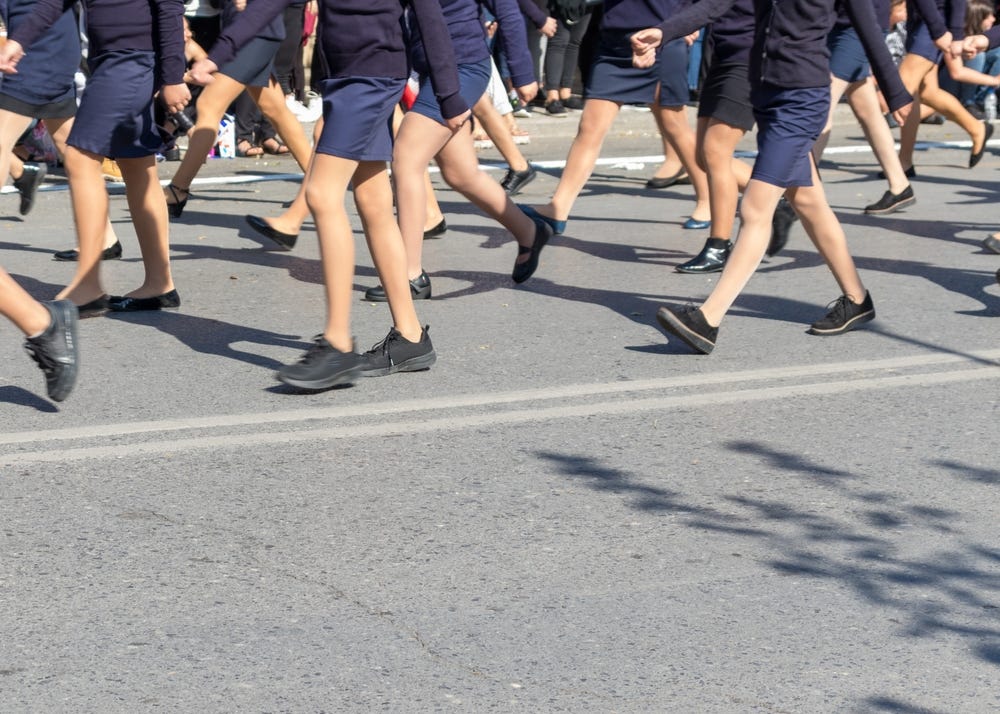
Then comes the parade. Bands take the lead, measured and bright. The drum keeps time. The children follow in year groups. The smallest ones step high to reach the beat. Teenagers try to look as grown-up as they feel. Teachers walk beside them with practical eyes that can spot a shoelace from fifty metres. The scouts come, and then the local associations. You may see a line of veterans. You may see a unit from the armed forces if you are in a larger town like Heraklion or Chania. People clap along the pavement. Grandparents lean forward to spot a grandson and call his name so quietly that he hears only them. It looks festive. It feels serious. That combination is part of the day’s meaning.
Flags, songs, and small rituals
There is no single soundtrack for Ohi Day on Crete, yet certain songs return. A rizitiko may be sung at a village ceremony, and the lyrics will sit calmly alongside the national anthem. A mantinada may be improvised for the day. It might rhyme pride with loss in the unforced way Cretan poetry often does. You will hear references to mountains and to eagles. You will hear the word freedom delivered as if it were a piece of fruit the singer was handing to a friend. After the formalities, families gather for coffee or lunch. The restaurants on the main streets are busy. The kafeneia in the back lanes are full of talk. Someone will raise a glass of tsikoudia and say to health. Someone else will add to freedom. It is not a cliché here. It is a habit. The island speaks in habits.
Children’s feet keep the memory alive
It is fashionable in some places to worry that national days will grow dusty. On Crete, the opposite often seems true. Schoolchildren take pride in holding the flag because their grandparents tell them why. Teachers prepare classroom work that explains the events of October 1940 without turning them into dry timelines. In the week before the holiday, you can watch a rehearsal on a street corner and see how quickly practice becomes performance. The little ones concentrate fiercely as they step in time. The older ones try not to grin. The parents form a ring of quiet attention. In that ring, you see how a community passes down a story without making it heavy or dull. The children feel it in their legs first, then in their hearts.
Why Ohi Day is not only about Athens
The event that gave Ohi Day its name happened in the capital. The meaning of the day, though, has always belonged to the whole country. In Crete, the story reaches back into archives that are not kept on shelves. It is not that the island refuses for the sake of theatre. It refuses because it has learned what happens when you do not. The old proverb that a door left ajar invites more wind than a door swung wide feels right for the Cretan temperament. People do not welcome bullies. They do not delight in conflict either. Ohi has never been an island word for anger. It has been a word for limits. This far, no further. That is why it sits so well next to hospitality. The visitor is welcomed in. The occupier is seen off.
Places where Ohi echoes on the island
Many places on Crete keep the memory close. In Chania, you can stand in the square where the parade makes its turn and feel the past walking a pace behind the present. The Venetian lighthouse watches and gives nothing away. Along the Akrotiri, the Allied War Cemetery at Souda Bay lies in calm lines of stone, and on 28 October, there is often a wreath laid there too. It reminds you that Ohi also meant sacrifice by thousands who had never seen Crete before they bled on it. In Rethymno, the sea runs bright against the long beach. The town remembers the parachutes that drifted down over the fields behind it. In Heraklion, the plain to the west still holds the wind in the same way it did when engines roared above it. At Maleme, the airfield is quieter now. The German cemetery on the hill is a sober place to stand. On Ohi Day, remembrance does not discriminate. The dead are acknowledged for what they suffered, and the living are reminded to keep their mercy as strong as their pride.
In the centre of the island, the old road near Anogeia folds around the contours of the mountain like a ribbon a child has dropped on the ground. The village itself carries the memory of its destruction in wartime and its refusal to bow. On Ohi Day, the speeches there hold an extra note. It is not a louder note. It is a steadier one. In the east, Viannos and the surrounding villages set their wreaths on memorials where lists of names are longer than some current class registers. In each case, the ceremony belongs to its place. Nothing feels generic. The island keeps its particularities close and gives them space to breathe.
Ohi and the older refusals of Crete
If you look for a straight line from the 1940s to earlier Cretan history, you will find it. The island’s memory of revolt in the nineteenth century has never been put to sleep. The Arkadi Monastery is a symbol not only of sacrifice but of a choice. When given a cruel menu, the people there chose the one that protected their dignity. There is a kind of whisper that moves between that moment and the one in 1940. It says that to be Cretan is often to be cornered, and that how you behave when cornered matters. The Ottomans learned this. The Venetians learned it. In the twentieth century, the Germans learned it. Each time, the island refused to let someone else write its story.
This is why Ohi Day on Crete cannot be reduced to a tale of flags and marching feet. It is also why the island’s celebrations are bright rather than sombre. The day marks a decision that felt natural to people who had already made it many times. It remembers the courage of soldiers on the Albanian front and the courage of women who hid weapons under blankets of laundry. It remembers the Allied men who slogged over the White Mountains to reach Sfakia and the fishermen who pushed out into rough seas to rescue them. It remembers the price paid by villages whose names were hardly known beyond their valleys. It gives the same attention to the unknown soldier as it does to a famous general. The island understands that the great events of history are made in kitchens and fields as often as in palaces.
The language of no on Crete
Greek has more than one way to say no. There is the formal oxi. There is the everyday ochi, clipped or drawn out depending on mood. On Crete, the sound can sometimes carry an extra weight, as if a mountain is sitting inside the vowel. Children learn to say it politely to a second slice of cake they cannot eat. Teenagers learn to say it firmly to a dare that does not suit them. Adults learn to say it clearly without raising their voice. It is part of the local music of speech. On 28 October, when people repeat the slogan, they are not only echoing the government. They are echoing their grandparents at the kitchen table. The word feels domestic and public at once.
Why Ohi Day is worth knowing if you are a visitor
If you are on Crete on 28 October, the day will touch your plans. It is a public holiday. Shops may open later or not at all. Streets will close for parades for an hour or two. A museum might be crowded or surprisingly quiet. Do not treat this as a nuisance. Treat it as an invitation. Stand with the families under the autumn sun and clap when the children pass by. If a small boy with a serious face holds the flag, clap a little louder. If you find yourself near a memorial as wreaths are laid, listen to the silence. You will hear birds and the wind and the sound of a page turning in a history you have just entered. Afterwards, go for a coffee. If someone clinks your cup with theirs and says to freedom, answer with the same word. It will be one of the most honest exchanges you have on your trip.
There is another reason to know this day. It helps explain the island’s personality even when the calendar shows a different date. You will understand a sharpness in a local’s refusal that might otherwise seem abrupt. It is not rudeness. It is a clarity that has been learned the hard way. You will also understand the openness of the welcome. The two things feed each other. A people that has defended its home fiercely can afford to set an extra plate on the table. That is the paradox of Crete. The more stubborn the defence of the threshold, the more generous the hospitality once you have stepped inside.
Small details you may notice if you look
In Heraklion on Ohi Day, the sea breeze pushes the flags into ripples so that the blue squares look like waves. In Rethymno, the parade seems to stop for a heartbeat when it passes the memorial outside the prefecture building. In Chania, the band’s snare drum ricochets off the stone of old Venetian buildings and makes the step feel older than it is. In smaller towns, you may see an old man in a black jacket standing apart from the crowd for a moment. He may be thinking of a cousin lost in 1944 rather than 1940. None of this is programmatic. It is not scripted. It is what happens when a day is both national and local. It wears a neat uniform and a village cap at the same time.
If you travel into the countryside that afternoon, you might pass a cemetery with fresh flowers. You might see the flag still tied to the school fence in a village where the wind comes down the slope in sudden gusts. You might see children on bicycles pretending to march as they turn into their own lane. You might hear a grandmother tell the story of 1940 with details that sound like they belong to her family. They probably do. On this island, even the national dates have family trees.
What Ohi teaches beyond politics
It is easy to treat national days as political. Ohi Day can be read that way. It was, after all, a state decision at a moment of world crisis. Yet on Crete, the lesson is more human. It is about finding the word no when it matters. It is about drawing a clear line around your values and standing by it without cruelty. The island’s history is full of scenes where that line was drawn and kept. Some of those scenes are violent because the invaders are not persuaded by polite language. Many of the scenes, though, are quiet. A family decides to hide someone in a cellar. A priest ferries a message along a goat path. A teacher writes a poem for children to recite that will put a seed of pride in them for when they are grown.
In that sense, Ohi Day is not only backwards-looking. It is a day that hands down a tool for the future. Children learn that refusal can be noble when it is made for the right reasons. Adults remember that there are costs and that paying them is part of being a community. Strangers learn that a small word can hold a continent of meaning when it is spoken by people who have lived with its consequences.
A brief timeline that helps the story breathe
There is no need to drown in dates, though a few help. The ultimatum arrives before dawn on 28 October 1940. The answer is no. Within hours, Greece is at war with Italy. Through late 1940 and early 1941, the Greek army fought on the Albanian front and won ground. In April 1941, Germany invades and the mainland falls. In May 1941, the Battle of Crete began with the airborne assault. After fierce fighting, Crete is occupied. The resistance grows. Reprisals follow. The island endures until liberation. Each of those stages has a Cretan face. A specific square. A specific valley. A particular family that still lives where the story happened. Ohi Day places a pin at the start of that sequence, but the thread runs forward and back through other eras of Cretan refusal.
The feel of the day in different corners of Crete
In the far west, the wind off the Gulf picks up in the late morning. The flag at the school in Kolymvari snaps smartly. The parades in Chania finish, and people drift to the market streets. Fishmongers shout prices more softly, out of respect or habit. Along the Akrotiri, the military presence is felt a little more because of Souda Bay. Several ceremonies may be held there, modest and precise.
In the centre, the highlands around Anogeia enjoy a bright sun that has already lost its summer bite. People put on jackets and do not take them off by noon. The clear air sharpens the sound of footsteps. The memorial stands where everyone passes. A few flowers look new. Someone has trimmed the bushes around the base.
Along the north coast between Rethymno and Heraklion, towns with two names, the Venetian and the Greek, wave their flags on both. Peraia and modern streets. Old harbours and new roads. The day ties the two halves together. You can sit in a café that sells croissants beside a street where a plaque uses the old script and think of how layers of time sit one above another and do not complain.
In the east, Agios Nikolaos gives the impression of a town that enjoys blue water more than history, yet it has its share of names cut into stone as well. The lake reflects flags neatly. Elounda wakes later than the rest, and then suddenly, everywhere is busy. On the Lasithi Plateau, where the windmills used to turn like white birds, the day is brisk and the memory sharp. Families gather at small memorials that you might miss on a casual drive. If you are a stranger and you stop to stand with them, you will be welcomed with a nod.
Food, laughter, and gravity
Greeks celebrate with food, and Cretans very much so. On Ohi Day, the meals after the parades are not feasts of ritual dishes, yet there is a feeling about them. People choose places that matter to them. They order simple things that feel right. Grilled fish, beans in tomato, snails with rosemary, lamb with artichokes if they can find it out of season, pilafi if they are lucky. Wine is poured and then stopped early in the afternoon because tomorrow is a school day. Laughter comes easily. The stories that get told at those tables carry small lessons. A father reminds his son that the flag is not a decoration. A grandmother tells her granddaughter about a relative who never came home. The mood is not heavy, yet the room holds its shape. That is how Crete usually does things. It does not make a show of sorrow or of joy. It lets them sit together and assume they can share the table.
What the day reveals about Crete’s future
History is only useful if it changes how we walk tomorrow. Ohi Day on this island is a rehearsal for that. It asks children to step in time and to hold their heads up. It asks adults to step aside for a moment and let the children lead. It invites the elderly to show their faces because their faces are the island’s archive. It reminds the authorities that respect is earned by presence rather than by speech. When it works well, you see a miniature of a healthy public life. People gather. They listen. They speak. They remember. Then they go about their day with a fresh layer of common purpose.
There is also a warning tucked into the day. Refusal can curdle into stubbornness if it is not attached to something larger. On Crete, the antidote has always been hospitality and a sense of humour. The island says no to occupation and yes to conversation. It says no to bullying and yes to friendship. If it forgets the second part, the first can harden the face. Ohi Day reminds people to keep both words in play.
Practical notes for the curious
If you want to see the heart of Ohi Day on Crete, be where the children are. Small villages give you the clearest view. A town gives you scale and the crispness of a marching band. Arrive a little early. The ceremonies tend to start on time because they depend on school timetables. Dress as if you are going to a friend’s family event. Clapping is welcome. Photographs are fine if you are discreet and kind. If a street is closed, walk the long way with a smile. The island appreciates patience. If you hear a speech you do not fully understand, listen for the rhythm. You will recognise the pause for the names and for the anthem even if the words are new to you. Later, if you visit a war cemetery, take your hat off and walk slowly. The wind at Souda Bay has a way of carrying the right tone all by itself.
A last word about why Ohi still rings on Crete
Crete is an island that never quite relaxes in history’s presence. It respects it, argues with it, sings to it, and sometimes glares at it. That is why the island is alive rather than preserved. Ohi Day is one of the cords that tie the present to the past without choking it. On a fresh October morning, the island says a small word in a strong voice. Children carry flags that are taller than they are. Old men stand with their hands folded behind their backs and their eyes narrowed against the light. Women in neat coats look like the pillars that they are. The band turns the corner, and the drum counts the steps. As the parade passes a memorial, a breeze lifts the ribbon and sets it dancing for a heartbeat.
You can be a visitor and still feel the thread pulling through you. You can be a local and feel it every year as if for the first time. You can remember a father who stood on that pavement thirty years ago and clapped for you as you march now for your own child. That is the measure of a day that matters. It keeps coming round, and each time it adds a line to the story and offers another chance to say the word that started it. No to fear. No to bullying. No to forgetting. On Crete, the word is short and the memory is long. That is why this island says Ohi with a steady voice, and why the echo carries so clearly over the olive groves and down to the sea.
Great article!
This is lovely, thank you